Types and testing standards for lightning impulse equipment
Jun 04, 2026
Lightning Impulse Equipment: Core Technology in High-Voltage Testing
Lightning impulse equipment serves as the core testing apparatus in the high-voltage testing field. Its primary function is to simulate, in a controlled manner, the transient high-voltage and high-current impulses generated by natural lightning discharges, thereby enabling scientific verification of the insulation performance and anti-interference capability of various power equipment and electronic systems. As power grid voltage levels continue to rise and equipment integration density increases, lightning impulse testing has become a critical link in product quality control and reliability assessment, with its technical specifications and standard systems becoming increasingly refined.
Working Principle and Basic Composition of Lightning Impulse Equipment
The core design concept of lightning impulse equipment originates from the Marx circuit principle, which is essentially an energy conversion structure based on "parallel charging and series discharging." During the charging phase, multiple stages of capacitors inside the device are connected in parallel to a DC high-voltage power supply through charging resistors, with each capacitor independently charged to a preset voltage value. When the discharge stage begins, the first-stage ignition ball gap is accurately triggered, causing the series ball gaps of each subsequent stage to break down and conduct sequentially. This instantly switches all stage capacitors into a series connection state. The voltages of each capacitor then superimpose, generating a pulsed voltage waveform with extremely high amplitude and very short duration at the output terminal. This design enables the use of lower-voltage power sources to generate impulse high voltages of several megavolts or even tens of megavolts, significantly reducing equipment manufacturing difficulty and cost.
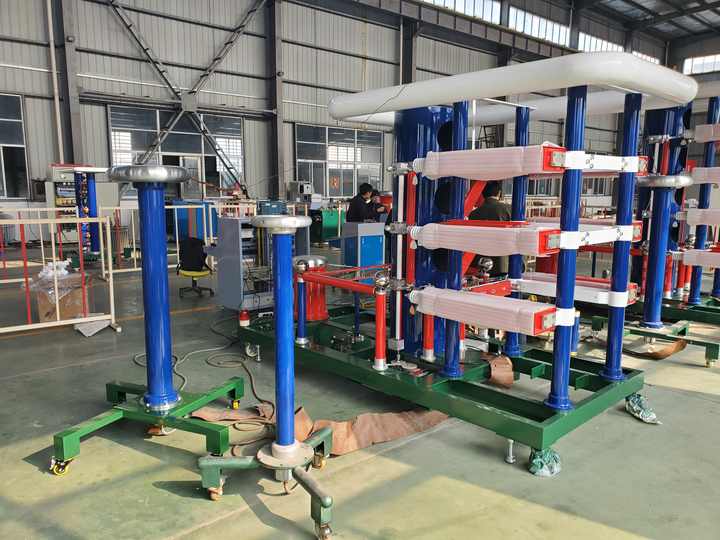
From a physical composition perspective, a complete lightning impulse test device consists of at least three core components: (1) the impulse voltage generator body, which integrates capacitors, charging resistors, wave-front resistors, wave-tail resistors, and ball-gap switches to realize the Marx circuit at each stage; (2) the measurement system, typically including a resistive-capacitive voltage divider or a differential-integral measurement device, combined with a digital recorder for waveform acquisition and analysis; and (3) the control and triggering system, responsible for regulating charging voltage, controlling discharge timing, and providing safety interlock protection. For applications requiring wave-cutting tests, an additional wave-cutting device must be installed to forcibly interrupt the shock wave at a predetermined time using the wave-cutting ball gap.
Equipment Classification and Technical Parameters
Depending on the simulation objectives and experimental purposes, lightning impulse equipment can be clearly divided into two categories: lightning impulse voltage generators and lightning impulse current generators. The former focuses on simulating the electrical stress effects of lightning overvoltage on equipment insulation structures, while the latter emphasizes reproducing the thermal stress and electromagnetic force effects when lightning current injects into voltage-limiting components such as lightning arresters.
In the field of high-voltage power system testing, the standard lightning impulse full wave is defined as a double-exponential waveform with a wavefront time of 1.2 microseconds and a half-peak time of 50 microseconds. These waveform parameters are not arbitrarily chosen but are derived from statistical induction based on extensive natural lightning observation data, reasonably representing the typical characteristics of induced lightning overvoltage on overhead transmission lines. In addition to full-wave testing, the lightning impulse chopped-wave test holds significant engineering value. The so-called "chopping" refers to the steep voltage jump caused by forcibly interrupting the full lightning impulse wave via an external gap during the rising edge or wavefront stage. The chopping time is typically set between 2 and 5 microseconds, simulating the sudden voltage drop phenomenon resulting from insulation flashover during a lightning strike. For ultra-high-voltage equipment where the maximum voltage exceeds 800 kV, international standards have significantly revised the positive tolerance of wavefront time, extending it to 100%, thereby allowing the wavefront time to reach 2.4 microseconds. This adjustment fully considers the differences in physical characteristics during the discharge process of ultra-long air gaps, reflecting how standard formulation adapts responsively to engineering practice.