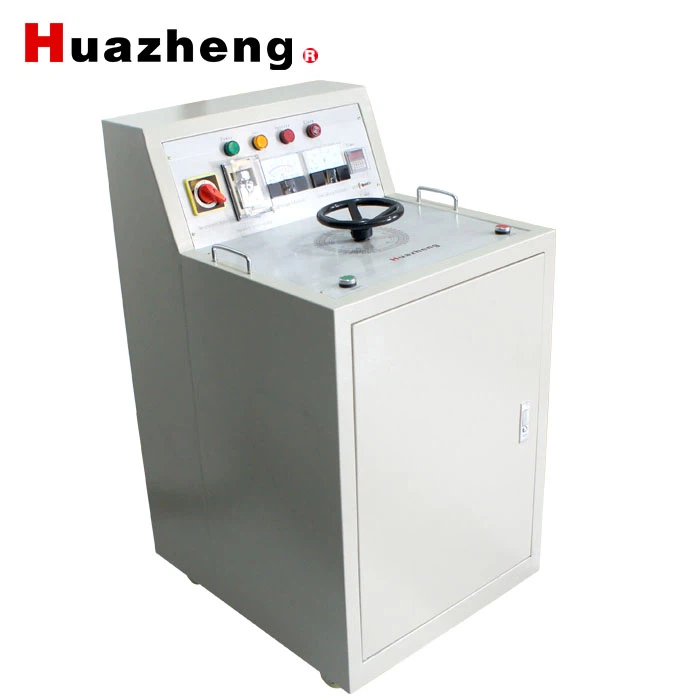
AC DC Hipot Tester

What is AC DC Hipot Tester


Two commonly used tests are the AC DC hipot tester. The main difference between the two tests is that High Voltage AC Hipot test applies an alternating voltage to the cable at a frequency between 50 to 60 Hz. On the other hand, a High Voltage DC Hipot test applies a direct voltage to the cable.

 
Benefits of AC DC Hipot Tester
 
01/

Detects Insulation Weaknesses: The primary advantage of the AC DC hipot tester is its ability to detect weaknesses or faults in insulation that could lead to electrical breakdown or hazards during operation. By applying a higher voltage than the normal operating voltage, the test stresses the insulation and identifies any areas of weakness.

02/

Early Detection of Potential Failures: AC DC hipot tester can uncover insulation defects at an early stage, allowing for corrective actions to be taken before the equipment is put into service. This helps prevent unexpected failures and reduces the risk of costly downtime or damage to other components.

03/

Comprehensive Testing: The AC DC hipot tester provides a comprehensive assessment of insulation integrity by subjecting the equipment to a higher voltage level than it would encounter during normal operation. This ensures that the insulation is capable of withstanding potential overvoltages or transient conditions.

04/

Standardized Test Procedure: AC DC hipot tester is a standardized procedure widely used in the industry, with established test voltages, durations, and acceptance criteria. This makes it easy to perform and interpret results consistently across different types of equipment and applications.

05/

Non-destructive Test: Despite applying higher voltages, the AC DC hipot tester is typically non-destructive to the equipment under test. It evaluates the insulation's ability to withstand the applied voltage without causing damage, allowing the equipment to remain functional after the test.

06/

Compliance Verification: AC DC hipot tester helps verify compliance with safety standards and regulations, such as those outlined by organizations like UL (Underwriters Laboratories), IEC (International Electrotechnical Commission), and IEEE (Institute of Electrical and Electronics Engineers). Meeting these standards is essential for ensuring the safety and reliability of electrical equipment.


First 12 Last 1/2

Why Choose us


Customized solutions

We understand that each client's needs are unique, so we can tailor solutions to meet your specific requirements to meet individual client needs.


Quality control

We strictly abide by the international quality management system and strictly control every link from raw material procurement, production process, product quality inspection, etc. to ensure the stability and reliability of our products and services.


Our service

The company has a professional sales team to provide you with high-quality pre-sales consulting services. During the order production process, customers can communicate with us at any time to understand the production progress. At the same time, we provide high-quality after-sales service to meet the different needs of customers.


What are the tips for using the AC DC Hipot Tester?


Like other instruments such as multimeter, transformer AC DC hipot tester is an instrument for measuring resistance. The theoretical basis of DC resistance and three-phase resistance is Ohm's Law. The equipment adopts an advanced programmable constant current source, which can apply a constant high-precision current to external loads. The accuracy of the data obtained by the instrument and the accuracy of the actual resistance are improved. These are not available for non AC DC hipot tester. For resistance measuring instruments without constant current source, due to the increase of load, the current and other data obtained by the instrument itself will have a certain deviation, which will affect the test results.

The main casing must be reliably grounded during the test.


When measuring the inductive load, do not remove the test line directly to avoid endangering the tester and equipment due to inductive discharge. The output terminal of the machine is equipped with a discharge circuit. When the output is turned off, the inductor will discharge energy through the instrument. Do not remove the test wire until the discharge indication is completed.


During the test, irrelevant items are not allowed to be stacked on or around the equipment panel.


Please check the power supply voltage before starting: AC 220V ± 10% 50Hz.


When replacing the fuse and accessories, please use the same model. Pay attention to moisture and oil contamination.


During the test, please confirm that the tested equipment has been powered off and disconnected from other live equipment.


Picking the Right AC DC Hipot Tester for the Job
Oil Immersed AC DC Hipot Tester
Sf6 Inflatable Testing Transformer
Oil Immersed High Voltage Testing Transformer
AC DC Hipot Test Set

Product Safety Certification
Before getting into the individual functions, it is important to point out that AC DC hipot tester is a generic term. Actual testing will require meeting different specifications, depending upon where in the world the product will be sold and used. The details of what constitutes a certified product is dependent upon a daunting number (hundreds) of safety standards and the region of the world where the device will be sold and used. Standards setting organizations include:
● EN/IEC (European).
● UL (US).
● CSA (Canada).
● CCC (China).
● JEIDA/MITI (Japan).
Manufacturers must submit samples of their products to recognized certification agencies. National Recognized Certification Laboratories (NRTLs) include UL, VDE, FM, ETL and others. The agency certification process is conducted to confirm compliance with the relevant standard(s). It is vitally important that your selection of AC DC hipot tester is capable of being set up to perform testing to meet the relevant standards.
Periodic inspection and calibration of test equipment is a standard requirement to maintain NRTL certification. Agency inspection will include check of hipot instrument calibration certification. This “cal cert” is typically required on an annual basis. (UL and other NRTLs require compliance certification with ISO17025.) Another common requirement prescribed by most NRTLs is a daily functional test of the hipot equipment.


Dielectric Withstand – Hipot
The basic hipot test applies a high voltage from the conductors to the chassis of the device-under-test (DUT). This test is often referred to as “dielectric” or “voltage” withstand. Its purpose is to confirm that the insulation and isolation of the non-conducting surfaces from the operating voltage is sufficient to avoid a shock hazard. The typical specification for this test is: 2x (normal operating voltage) + 1000V.
Both AC DC hipot tester are possible and, in general, the same test should use the same type of voltage as it would be during normal operation. However, if a DC hipot test is used on an AC circuit, the hipot voltage should be two times the peak (2 x 1.4 x RMS) + 1000V.
Depending on the applicable standard, units pass this test if either:
● The leakage current measured is less than the maximum allowable current.
● No breakdown occurs, i.e., no sudden and uncontrolled flow of current
For double-insulated products, higher voltages will often be specified in the test standard. In addition, this class of device typically requires special fixturing to connect the non-conductive outer shell to a conductive element.
Defects that are often detected with the hipot test include contamination (dirt, debris) and lack of proper spacing (creepage and clearance) of components. Creepage is measured across surfaces, clearance is the air gap between components. Contamination would likely cause an unacceptable level of leakage current. Clearance problems could result in breakdown.


Desirable Dielectric Withstand Test Features
● Adjustable maximum output voltage:
5KV is adequate for many applications.
Higher voltages (up to 30KV) may be required.
● AC and DC outputs.
● Excellent regulation – both line and load.
● Controllable ramp rates, dwell times and discharge features.
● Phase angle measurement of leakage current – capacitive coupling detection.
● Some standards allow for in-phase and quadrature current to be measured separately. Leakage current due to capacitive coupling may not be a safety concern.
● Min/max pass/fail current limits.
● Separate limits during ramp.
● Programmable multichannel testing.


Insulation Resistance
Insulation resistance testing is likely to be required in motor winding, transformer winding and other applications involving cabling or insulated wire. Insulation resistance testing typically involves confirming that the resistance exceeds a defined high resistance value.
In many instances, insulation resistance needs to be measured between several conductors. Examples include cable/connector assemblies, multiconductor cables and relays. To make this measurement, all the conductors except one are shorted together and the test voltage is applied from the remaining conductor across the bundled ones. Each wire is then, in turn, tested in this fashion .
Desirable Insulation Resistance Test Features
● Wide range of selectable test voltages.
● Accurate/repeatable high resistance measurement.
● Programmable high-voltage switching accessory.
● Multichannel programmable testing.
● “Pass” on steady and increasing voltage.


Ground Continuity
Ground continuity testing is performed to confirm that the conductive chassis of a device is safely connected to the earth ground pin on the power plug. This assures protection against shock hazards even if the equipment suffers an internal short to the chassis. The current would be shunted via the ground wire and would likely trip the breaker or blow the fuse.
Ground continuity is performed by applying a low current (e.g., 50 mA) and calculating the resistance from the ground pin on the power plug to selected locations on the exposed surfaces of the DUT.
Desirable Ground Continuity Test Features
● Accurate, repeatable low resistance meter.
● Plug adaptor accessory to speed testing.


Ground Bond
Where ground continuity measures the resistance of the safety ground connection, the ground bond test assures the integrity of the connection. Using the same test setup, a high current is passed through the circuit. If the ground bond is solid, the current passes without a change in resistance. If weak, the resistive heating of the current would induce a failure of the bond.
Desirable Ground Bond Test Features
● Accurate high current source.
● Programmable test currents and test times.
● Plug adaptor accessory to speed testing.
● 4-wire milliohm meter – providing a Kelvin connection for highly accurate low resistance measurements.


Insulation Testing: Megohmmeter Or AC DC Hipot Tester


Megohmmeters
A modern megohmmeter (or megohm meter) applies a dc voltage to a DUT and measures the dc current (nanoamps or microamps). Applying Ohms Law, the corresponding resistance value is then shown on the meter's analog or digital display. This instrument is often called a megger, which is a term trademarked by the Megger Group in 1907.


MegohmmeterIn a typical megohmmeter, the user can select from several voltage levels. For cables or equipment with rated voltage up to 500V, the maximum dc test level is usually twice the rated voltage. Above a 500V rating, the maximum level is closer to the rated voltage (e.g. 5000V for a 4100V system). The equipment manufacturer may have more specific test recommendations.


Due to capacitance and dielectric effects in the DUT, it takes time for the reading to stabilize after the voltage is applied. Initially, the reading is dominated by capacitance charging. Absorption currents may be significant for 20 seconds or more. Usually, IR readings are made after 60 seconds to allow these effects to settle out.


Techniques
Two techniques can aid in insulation condition assessment. The first is to apply the voltage in increasing steps. Degraded insulation will show a declining IR value as the test voltage increases. For accurate results, dwell time at each step should be controlled. To make this an easy test, some megohmmeters include a function to automatically step up the voltage at programmed intervals.


Another assessment technique is to compare IR readings with previous test results. Since the megohmmeter uses a very low test current, it does not damage the insulation. Periodic IR testing will identify insulation degradation over time and the need for preventive maintenance. An accurate comparison requires measurements at the same voltage and dwell time. Moisture affects the IR readings, so care should be taken to perform the tests under similar temperature and humidity conditions.


Parameters
Two parameters derived from insulation resistance measurements are dielectric absorption ratio (DAR) and polarization index (PI). Advanced digital megohmmeters have dedicated functions to measure and display these parameters. DAR is the IR at 60 seconds divided by the IR at 30 seconds. A value less than 1 shows the resistance is decreasing with time, which indicates a failing DUT. The polarization index is used on motors and generators to assess the amount of impurities in the windings and their cleanliness. PI is the IR at 10 minutes divided by the IR at 1 minute. Some equipment standards specify minimum PI values. A ratio greater than 1.5 is generally adequate.


Handheld megohmmeters that source up to 1000V are available from several manufacturers. Portable units can supply up 15kV. Multi-purpose instruments combine IR measurements with other test functions, such as a multimeter. This photo shows a typical handheld megohmmeter, portable megohmmeter, megohmmeter/DMM and AC DC hipot tester.


AC DC hipot tester
A hipot (short for high potential) test determines the ability of electrical insulation to withstand normally occurring over-voltage transients. The AC DC hipot tester applies high voltage to the insulation barrier of the DUT and verifies there is no breakdown. It is a simple pass/fail test performed as a type test on a representative sample unit or as a routine production test. Maximum allowed leakage is usually in the range of 0.1 to 5mA, or as specified in the test standard. The actual leakage value for each DUT may be recorded for quality assurance.


AC DC hipot testerMany standards (such as IEC 60950) specify an ac test voltage that is twice the operating voltage plus 1000V. Most allow the use of either ac or dc voltage. The test setup and procedures are identical for ac and dc, although the dc level should be equal to the ac voltage peak. The test time is normally 1 minute, but in some situations, such as high volume production testing, a shorter test time may be permitted at a higher voltage.


Typically, a hipot test is performed on the mains wiring of electrical equipment. One lead of the tester is connected to safety ground (earth ground). The other lead is connected to the line and neutral power leads. Often the AC DC hipot tester has a built-in ac receptacle to make these connections (as shown in the photo).


If the circuit under test has a power line filter, an ac AC DC hipot tester may indicate a failure due to current flow to earth thru the Y capacitors. The safety standard usually allows the user to disconnect these capacitors prior to testing or increase the upper current limit to compensate for the additional leakage. Alternatively, a dc test voltage can be used. Most AC DC hipot tester also include a low limit to ensure the test fails if the DUT is not connected or the test is interrupted. Unlike megohmmeters, which are usually battery-powered, almost all AC DC hipot tester require ac power.


Our Factory

Beijing Huazheng Technology Co., Ltd. was established in 2023, headquartered in Beijing, China. It is an enterprise with outstanding innovation capabilities in the field of high voltage testing equipment. Our mission is to provide customers with high-quality and efficient solutions, with the goal of promoting social progress and sustainable development. Our values are integrity, innovation, and collaboration, always putting customers first. Our strengths lie in our technical strength, quality control, customer service, and partnership. We have a professional R&D team and advanced production equipment, which can provide innovative solutions and high-quality products. We strictly adhere to the international quality management system, ensuring the stability and reliability of our products and services. We have established a comprehensive pre-sales, sales, and after-sales service system to provide customers with comprehensive support and solutions. The long-term cooperative relationship established with well-known domestic and foreign enterprises has further promoted the development of the industry. We will continue to uphold the concepts of integrity, innovation, and excellence, and contribute more to the development of the high voltage test equipment . Choose Beijing Huazheng Technology Co., Ltd., choose trust and success.

productcate-1-1


Asked Questions

Q: What is the difference between AC and DC hipot testing?

A: The DC hipot tester will use a higher voltage than the AC hipot tester, and the DC hipot test will use the DC voltage, whereas the Ac hipot test uses AC voltage at 50/60 Hz. DC hipot tester provides a more accurate reading of the leakage current as it only reads real current.

Q: What is the acceptable leakage current for a hipot test?

A: Because the insulation resistance and reactance of the stray capacitance is so high, the ac test current can be simplified to the leakage current at 250 V times the ratio of hi-pot test voltage to 250 V. If the test voltage is 3000, then the test current would be 3000/250 x 0.5 or 6 mA.

Q: How long does a DC hipot test take?

A: The voltage applied to the winding must be gradual, to avoid exceeding the maximum test voltage. Its duration is typically one minute (most cases), and can be as long as ten minutes (some cases), counted from when the maximum voltage value is reached.

Q: How does a AC DC hipot tester work?

A: How AC DC hipot tester Work. A DC over-voltage potential is applied to the windings, and the current to ground is measured with a resolution of 1 pA for the iTIG and 10nA for the Power Pack. This current includes leakage from the windings as well as other currents such as surface currents on the outside of the windings.

Q: What are the rules for hipot testing?

A: A general rule of thumb for establishing the hipot test voltage is two times the working voltage + 1000 V. For a working voltage of 220 V, the rule of thumb test voltage is (2 × 220 + 1000) = 1440 V. Therefore, 1500 V is a common hipot test voltage. Hipot test voltage may be specified as either ac or dc.

Q: Why we need so high voltage in the AC DC hipot tester?

A: A Hipot test is necessary to test the stress of an electronic device for safety and quality purposes. Under high voltage it checks that there is no breakdown or perforation occurring, and that insulation distances on the line and in the air are respected.

Q: What causes AC DC hipot tester failure?

A: A hipot failure is caused by a breakdown in the insulation. It is indicated by an abrupt increase in the current flowing as a result of the application of the test voltage. A real breakdown is usually obvious: the arc can be seen. Sometimes it cannot be seen but it can be heard.

Q: What frequency is a AC DC hipot tester?

A: High potential (hipot) testing procedures for motor and generator windings are usually performed with 50/60 Hz AC or DC as the power source.

Q: Is a pressure test the same as a AC DC hipot tester?

A: A dielectric withstand test (also known as a pressure test, high potential or hipot test) is an electrical test used to measure the effectiveness of a component's or product's insulation. The test may be between mutually insulated sections of a part or energized parts and electrical ground.

We're professional ac dc hipot tester manufacturers and suppliers in China, specialized in providing high quality customized service. We warmly welcome you to buy ac dc hipot tester for sale here from our factory. For price consultation, contact us.

ac dc withstand voltage tester, 10kva 100kv ac dc hipot tester, 100kv ac dc hipot tester

(0/10)

clearall