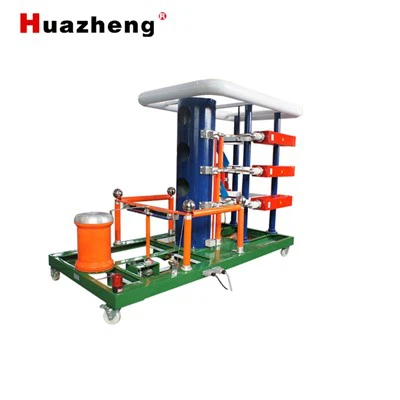
Impulse Voltage Generator

What is Impulse Voltage Generator


An impulse generator is an electrical apparatus which produces very short high-voltage or high-current surges. Such devices can be classified into two types: impulse voltage generators and impulse current generators.


Benefits of Impulse Voltage Generator

Simulating Real-world Conditions: High-voltage impulses that simulate transient overvoltage circumstances seen in real-world electrical systems, including lightning strikes or switching surges, can be generated using impulse voltage generators. This enables engineers to evaluate how well equipment insulation can tolerate such occurrences.


Accuracy and Precision: These generators are designed to deliver precise voltage waveforms with known characteristics, ensuring consistent and reliable testing results. Engineers can accurately measure the breakdown voltage and evaluate the insulation performance of the tested equipment.


Customizable Parameters: Impulse voltage generators often allow for the adjustment of parameters such as voltage amplitude, rise time, and waveform shape. This flexibility enables engineers to tailor the testing conditions to match specific application requirements or standards.


High Energy Capability: Impulse voltage generators can deliver high-energy pulses, which are necessary for testing high-voltage and high-power equipment. They are capable of generating impulses with energy levels sufficient to stress insulation systems to their limits without causing damage to the generator itself.


Safety: These generators are designed with safety features to protect both the equipment under test and the personnel conducting the tests. Safety interlocks, shielding, and grounding mechanisms are typically incorporated to minimize the risk of accidents or damage during testing.


Cost-effectiveness: While impulse voltage generators represent a significant investment, they offer long-term cost savings by helping to identify potential insulation weaknesses early in the development or production process. This can prevent costly failures and downtime in the field.


Compliance Testing: Impulse voltage testing is often a requirement for compliance with industry standards and regulations. Using dedicated impulse voltage generators ensures that the testing procedures meet the required standards and provide traceable documentation for regulatory purposes.


Why Choose us


Customized solutions

We understand that each client's needs are unique, so we can tailor solutions to meet your specific requirements to meet individual client needs.


Quality control

We strictly abide by the international quality management system and strictly control every link from raw material procurement, production process, product quality inspection, etc. to ensure the stability and reliability of our products and services.


Our service

The company has a professional sales team to provide you with high-quality pre-sales consulting services. During the order production process, customers can communicate with us at any time to understand the production progress. At the same time, we provide high-quality after-sales service to meet the different needs of customers.


Construction of Impulse Voltage Generator


It must charge the impulse capacitance C1 of an impulse voltage generator SUG255 from a direct current (DC) source. A rectifier and step-up transformer form the supply. To prevent pre-stressing effects inside the insulations from affecting the breakdown strength, charging durations should be at least 3 to 10 seconds long. This is because each voltage application leaves behind pre-ionizing effects.


Charging via thyristors regulated DC source is now a practical option. Various resistive materials, including wire, liquid, and composites (carbon, etc.), may be used to construct the resistors.


Thus, the comparatively expensive non-inductive wire-wound resistors are utilized for this purpose. From the perspective of circuit oscillation, they are considered fairly adequate.


These resistors should be positioned so that can be quickly swapped out for new ones since their charging needs may vary depending on the wave produced. The capacitors chosen for usage in an impulse voltage generator significantly impact its design.


Conventionally, high-discharge-rate capacitors with oil paper insulation are used. It is common practice to substitute the material oil with special fluids with greater permittivity to achieve the same capacitance with a smaller capacitor.


One benefit of this design is that it allows for stacking capacitors in a vertical column. Each stage is separated from the next by supports that mimic the shape of the capacitors but lack the dielectric.


The gaps between the connection spheres are stacked horizontally on arms and are changed using a motor and an indicator under remote control. The spark gaps cascade perfectly with this configuration thanks to their mutual irradiation.


When using the right gas mixes, switching performance improves. When the impulse voltage generator is not in use, the capacitors need to be discharged to the ground. Due to the relaxation phenomena, DC capacitors may rapidly accumulate large voltages after being short-circuited for a brief period.


Types of Impulse Voltage Generator


Impulse generators

  • Power surges pose a significant problem for every electronic device and are every circuit designer's worst fear. The term “impulse” is widely used to describe these spikes in voltage, which are normally measured in the kilovolt range and last for just a few microseconds.
  • Lightning is an example of a natural phenomenon that generates impulse voltage, which can identify by its distinctive high or low fall time followed by a very high-rise time of voltage. Our products must be tested for resilience against impulsive voltage since it may cause catastrophic failure in electrical equipment.
  • Here, a device called an impulse voltage generator produces short bursts of very high voltage or current inside a carefully monitored testing environment. The purpose and operation of an Impulse Voltage Generator are discussed here. Consequently, let's get into action.
  • As was previously mentioned, an impulse generator creates very brief, extremely high-voltage, or high-current surges. As a result, there are two distinct impulse generators: those that produce a voltage spike and those that have a current wave. But here, we'll talk about impulse voltage generators.


Impulse voltage generator

  • A set of capacitors, resistors, and spark gaps make up an impulse voltage generator. After being charged in parallel through resistors from a high-voltage direct-current source, the capacitors are connected in series and discharged via a test item via a simultaneous spark-over of the spark gaps.
  • The spark gap discharges the impulse current via resistances, inductances, and the item under test. The current impulse generator comprises numerous capacitors that are charged in parallel by a high-voltage, low-current, direct-current source.
  • Transformer testing, impulse current testing of surge arresters, and even components of wind turbines or airplanes are specialized tests that may be performed using customized impulse voltage generators. Because of the system's modular nature, it may use in various settings, including manufacturing and research & development facilities.


Marx generator

  • Among them is the Marx generator because Erwin Otto Marx initially suggested it in 1923. Multiple capacitors are charged in parallel using resistors, simulating a high-voltage direct-current source, and then linked in series and discharged via a test item with a single spark across the spark gaps.
  • The spark gap discharges the impulse current via resistances, inductances, and a test item in parallel after being charged by a high-voltage, low-current, direct-current source.


Circuit of the impulse generator

  • The impulse voltage generators use a tweaked version of the Marx multiplier circuit. As the generator progresses through its phases, positive and negative DC voltages up to 100 kV are applied across spark gaps connecting the generator's array of impulse capacitors in series, generating electrical impulses.
  • The front and tail resistors in the generator stages allow for fine-tuning the rise and fall times of the roughly double-exponential impulses. Internal inductances are kept low, and voltage is shaped smoothly by keeping the discharge loop short.


Components of the impulse voltage generator

  • Four glass-fiber reinforced plastic columns provide insulation for the impulse generator's internal components. Each generator stage is structurally sound, thanks to rectangular frames. Each third stage has a collapsible platform that it may access to swap out the resistors.
  • An insulated ladder provides safe access to these platforms at the generator's phases. To ensure that the switching spark gaps throughout all stages always have clean air for reliable triggering, they are often housed in a fifth insulating column with a small air over-pressure.
  • The test generator's safety features include two earthing switches, and two motor-operated earthing ropes, which short-circuit all impulse capacitors when the impulse generator is turned off.


Application of Impulse Voltage Generator
 

High Voltage Testing: Impulse voltage generators are used to test the insulation strength of electrical equipment, such as power transformers, circuit breakers, cables, and insulators. The generated impulse voltage stresses the insulation, allowing engineers to ensure its ability to withstand transient overvoltages.


Surge Arrester Testing: Surge arresters protect electrical equipment from overvoltages caused by lightning strikes or switching surges. Impulse voltage generators are used to test the performance and reliability of these surge protection devices.


Lightning Protection Testing: Impulse voltage generators are used to evaluate the effectiveness of lightning protection systems and grounding arrangements in various structures, such as buildings, communication towers, and power transmission lines.


Research and Development: In research settings, impulse voltage generators are employed to investigate the behavior of electrical discharges, breakdown phenomena, and other transient effects.


Calibration and Certification: Impulse voltage generators are used for the calibration and certification of voltage measurement systems and protective devices.


Use And Maintenance Of Impulse Voltage Generator


Make sure that the wiring terminals of the main circuit are not loose and the voltage adjustment brushes are firmly in contact.


For long-term use, please use a 500V megger to check the insulation resistance of the main circuit to the ground. The resistance should be at least 0.5 megohm.


The input voltage matches the voltage value on the nameplate, the difference between the two values is ±10%, and the frequency is 50HZ.


The current gear switch cannot be operated under load.


During the operation, rotate the hand wheel evenly and slowly to avoid damage to the regulator.


Full load working time should not exceed 5 minutes, continuous working time should be less than 2.5 minutes, but working time should exceed 10 minutes.


The shell of the current booster has a grounding terminal, which should be well grounded during use.

Lightening Impulse Voltage Test Equipment


What is Impulse Voltage Generator working principle?


Impulse voltage generator is a device used for testing and inspecting electrical equipment and cables. Its working principle is to generate high-energy, short-term impulse current, and simulate the current surge in abnormal situations such as short circuits in equipment or cables.


When an impulse current occurs, its characteristics are high peak, short time, high frequency, and high energy, which can simulate faults and various abnormal situations in equipment or cables. The impulse voltage generator will store the charge in the capacitor through the discharge capacitor, and then release the charge, generating a high-energy, short-term current pulse. This type of electrical pulse forms a short circuit loop in the connected equipment or cable, and analyzes the status and reliability of the equipment or cable by detecting parameters such as current waveform, amplitude, and frequency.


The working principle of the impulse voltage generator is relatively simple, but its operation and maintenance require a certain level of professional knowledge and skills. When using an impulse voltage generator for testing, it is necessary to correctly wire the equipment or cable and set appropriate testing parameters to avoid damaging the equipment or cable. At the same time, accurate test data analysis and result judgment should also be conducted in order to carry out reasonable maintenance and repair of equipment or cables.


Our Factory

Beijing Huazheng Technology Co., Ltd. was established in 2023, headquartered in Beijing, China. It is an enterprise with outstanding innovation capabilities in the field of high voltage testing equipment. Our mission is to provide customers with high-quality and efficient solutions, with the goal of promoting social progress and sustainable development. Our values are integrity, innovation, and collaboration, always putting customers first. Our strengths lie in our technical strength, quality control, customer service, and partnership. We have a professional R&D team and advanced production equipment, which can provide innovative solutions and high-quality products. We strictly adhere to the international quality management system, ensuring the stability and reliability of our products and services. We have established a comprehensive pre-sales, sales, and after-sales service system to provide customers with comprehensive support and solutions. The long-term cooperative relationship established with well-known domestic and foreign enterprises has further promoted the development of the industry. We will continue to uphold the concepts of integrity, innovation, and excellence, and contribute more to the development of the high voltage test equipment . Choose Beijing Huazheng Technology Co., Ltd., choose trust and success.

productcate-1-1


Asked Questions

Q: How does an impulse voltage generator work?

A: The impulse voltage generator comprises many capacitors that are also charged in parallel by a high-voltage, low-current, direct-current source, but it is discharged in parallel through resistances, inductances, and a test object by a spark gap.

Q: What is the purpose of impulse voltage generator?

A: Impulse generators are a perfect solution for carrying out impulse tests on HV or UHV cables as well as on MV and HV power transformers. The complete test system consists of a charging rectifier, impulse stages according to the “Marx Circuit”, an impulse voltage divider and impulse voltage measurement system.

Q: What is the maximum output voltage of impulse generator?

A: SGΔA impulse test systems are used to generate impulse voltages from 10 kV to 2400 kV simulating lightning strokes and switching surges. The total charging voltage range covers from 600 kV to 2600 kV with a stage energy of 5 or 10 kJ.

Q: Why is controlled tripping necessary in an impulse generator?

A: Tripping of the impulse generator is effected by a trip pulse which produces a spark between the trigger electrode and the earthed sphere. Due to space charge effects and distortion of the field in the main gap, spark over of the main gap Fig. 3.27 applied for correct operation.

Q: Which circuit is used as an impulse generator?

A: Modified Marx circuits are used to generate high voltage impulses, with capacitors charged in stages through high resistance and discharged through spark gaps.

Q: What is the output waveform of the impulse voltage generator?

A: The surge current generators generate standard impulse currents with waveform 8/20 µs according to IEC, EN, VDE. Pulse current output amplitude is controlled by preset charging voltage and can be adjusted up to the maximum value of the special type of generator.

Q: What is a multi-stage impulse generator?

A: Erwin Otto Marx provided a multistage impulse generator circuit in 1924. This circuit is specifically used to generate high impulse voltage from a low voltage power source. The circuit of multiplexed impulse generator or commonly called as Marx circuit can be seen in the below image.

Q: Why do we need impulse voltage?

A: High impulse voltages are required for testing purposes to simulate overvoltages that occur on power system due to lightning or switching action.

Q: Why do we design impulse voltage generator?

A: The testing of lightning protection device such as surge arrester is very important to determine this device can be operates in normal condition. Hence, the impulse voltage generator is developed to carry out the test..

Q: What is the function of the impulse generator?

A: The impulse voltage generator can generate a wide range of voltage and energy to simulate lightning impulse, lightning chopping wave, operation impulse and other waveforms.

Q: What are the applications of impulse voltage generator?

A: Also, steep-front impulse voltages are sometimes used in nuclear physics experiments. High impulse currents are needed not only for tests on equipment such as lightning arresters and fuses but also for many other technical applications such as lasers, thermonuclear fusion, and plasma devices.

Q: How does an impulse voltage generator work?

A: Impulse voltage generator is a device used for testing and inspecting electrical equipment and cables. Its working principle is to generate high-energy, short-term impulse current, and simulate the current surge in abnormal situations such as short circuits in equipment or cables.

Q: How will you obtain control of impulse generator?

A: The control or trigger pulse is applied between these two electrodes on the rod. The trigger electrode (pin) has an auxiliary circuit which can supply high voltage of about 10 kV to it. Since the pin is sharp, corona is produced at a relatively low voltage causing it to spark over to the earthed electrode.

Q: What is the purpose of impulse voltage generator?

A: Impulse generators are a perfect solution for carrying out impulse tests on HV or UHV cables as well as on MV and HV power transformers. The complete test system consists of a charging rectifier, impulse stages according to the “Marx Circuit”, an impulse voltage divider and impulse voltage measurement system.

Q: How to generate high impulse current?

A: In high impulse current generation, a bank of capacitors connected in parallel are charged to a specified value and are discharged through a series R-L circuit.

Q: What is impulse voltage capacity?

A: This characteristic expresses, in kV peak, the value of voltage which the equipment is capable of withstanding. without failure, under test conditions. Generally, for industrial circuit-breakers, Uimp = 8 kV and for domestic types, Uimp = 6 kV.

Q: What is the impulse voltage of a impulse voltage generator?

A: This lightning stroke on the line conductor causes impulse voltage. The terminal equipment of transmission line such as power impulse voltage generator then experiences this lightning impulse voltage. Again during all kind of online switching operation in the system, there will be switching impulses occur in the network.

Q: What is the maximum output voltage of impulse voltage generator?

A: SGΔA impulse test systems are used to generate impulse voltages from 10 kV to 2400 kV simulating lightning strokes and switching surges. The total charging voltage range covers from 600 kV to 2600 kV with a stage energy of 5 or 10 kJ.

Q: Which circuit is used as an impulse voltage generator?

A: Modified Marx circuits are used to generate high voltage impulses, with capacitors charged in stages through high resistance and discharged through spark gaps.

Q: What is the function of the impulse voltage generator?

A: Impulse voltage generator are used to test electrical equipment by generating high voltage surges over short durations, simulating events like lightning strikes.

We're professional impulse voltage generator manufacturers and suppliers in China, specialized in providing high quality customized service. We warmly welcome you to buy impulse voltage generator for sale here from our factory. For price consultation, contact us.

impulse voltage generator, impulse high voltage generator, Lightning Impulse Voltage Generator

(0/10)

clearall