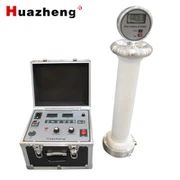
Is a VLF test AC or DC?
Oct 31, 2025
1. What is VLF Testing?
VLF stands for Very Low Frequency. It is a diagnostic test used primarily for medium and high-voltage cables (and other electrical apparatus like rotating machines and switchgear) to assess the integrity of the insulation.
The standard power frequency in most of the world is 50 Hz or 60 Hz. A VLF test uses a sinusoidal AC waveform at a frequency typically in the range of 0.1 Hz to 0.01 Hz. This is the "Very Low Frequency."
2. Why Use VLF AC Instead of Power Frequency AC?
Testing a long cable at its rated AC voltage (e.g., 15 kV at 60 Hz) requires a massive, heavy, and expensive test set because the cable has significant capacitance. The test set must supply a large amount of reactive power (VARs) to charge and discharge this capacitance 60 times per second.
By drastically reducing the frequency to 0.1 Hz, the capacitive reactance (Xc = 1 / 2πfC) increases by a factor of 600 (compared to 60 Hz). This means the test set only needs to supply 1/600th of the current, making the equipment much smaller, more portable, and more affordable.
3. The Crucial Comparison: VLF vs. DC Testing
This is where the "AC or DC?" confusion often arises. For decades, DC Hipot (High Potential) testing was the standard method. However, it was discovered that DC testing has significant drawbacks and can even be harmful to modern polymeric insulation (like XLPE), while VLF is a much better alternative.
Here's a comparison:
| Feature | DC Hipot Test | VLF AC Test |
|---|---|---|
| Voltage Type | Pure DC | Sinusoidal AC at 0.1 Hz |
| Stress on Insulation | Applies stress based on insulation resistance. Can create space charges within the insulation. | Applies stress based on the dielectric's capacitance, closely simulating operating conditions. |
| Effect on Defects | Can "heal" over some voids and defects temporarily. May not reveal weaknesses that would fail under AC stress. | The alternating polarity aggressively probes defects like water trees and voids, causing them to break down and be identified. |
| Risk of Damage | High risk of damaging modern XLPE cables due to space charge accumulation, which can lead to immediate or future failure. | Much safer for the insulation. If a cable fails, it fails at a weak point that was likely to fail soon in service anyway. |
| Field Replication | Does not replicate the electrical stress experienced during normal AC operation. | Closely replicates the AC stress of normal operation, just at a much slower rate. |