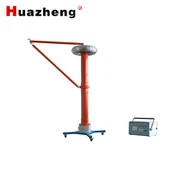
What is vlf hipot testing?
Nov 24, 2025
VLF Hipot Testing (Very Low Frequency High Potential Testing) is a non-destructive electrical test used to evaluate the insulation integrity of electrical equipment and components. Below is a detailed breakdown of its key aspects, purpose, methodology, and applications:
1. Core Definition
VLF: "Very Low Frequency" refers to the test voltage frequency, typically 0.1 Hz to 0.01 Hz (far lower than the standard 50/60 Hz power frequency).
Hipot: Short for "High Potential," meaning the test applies a significantly higher voltage than the equipment's normal operating voltage to stress the insulation.
Goal: Identify insulation weaknesses (e.g., cracks, moisture, contamination, or manufacturing defects) that could lead to breakdown during normal operation-without damaging healthy insulation.
2. Why Use VLF Instead of Power Frequency?
Traditional hipot testing at 50/60 Hz requires large, heavy transformers to generate high voltage (impractical for field use). VLF solves this by:
Reduced Equipment Size: Lower frequency means smaller, lighter test sets (critical for on-site testing of large assets like cables or transformers).
Mimicking DC Stress Safely: VLF voltage behaves like "quasi-DC" (slowly reversing polarity), which effectively detects insulation defects (e.g., moisture ingress) that might be missed by AC testing. Unlike pure DC testing, VLF avoids charging the insulation (which can cause damage or require lengthy discharge times).
Compliance with Standards: Aligns with global standards (e.g., IEEE 400, IEC 60502) for testing high-voltage insulation in cables, motors, and transformers.
3. How VLF Hipot Testing Works
The test follows these key steps:
Step 1: Preparation
Isolate the equipment from the power system and ground non-tested components.
Ensure the insulation is clean and dry (moisture can skew results).
Step 2: Voltage Application
A VLF generator applies a sinusoidal or square-wave voltage (typically 2–5x the equipment's rated voltage) to the insulation for a specified duration (e.g., 15–60 minutes for cables).
Example: For a 11 kV cable, the test voltage might be 25–35 kV (VLF).
Step 3: Monitoring & Evaluation
Measure two critical parameters to assess insulation health:
Leakage Current: The small current that flows through/around the insulation during the test. A sudden spike or abnormally high leakage current indicates a defect (e.g., a pinhole in the insulation).
Dielectric Discharge (Partial Discharges): Tiny electrical arcs within insulation defects. VLF testing can detect these discharges, which are precursors to insulation failure.
If leakage current remains stable and no discharges are detected, the insulation is deemed acceptable.
4. Key Applications
VLF Hipot Testing is widely used for high-voltage (HV) and medium-voltage (MV) equipment where insulation reliability is critical:
Power Cables: Underground, submarine, or MV/HV distribution cables (the most common application).
Transformers: Power and distribution transformers (to test winding insulation).
Motors & Generators: Large AC/DC motors and generators (stator winding insulation).
Switchgear: MV/HV circuit breakers, bushings, and insulated conductors.
5. Advantages & Limitations
Advantages:
Non-Destructive: Stresses insulation without damaging healthy material.
Portable: Compact test sets enable on-site (field) testing.
Sensitive to Defects: Detects moisture, cracks, and contamination better than some AC/DC tests.
Cost-Effective: Avoids costly failures by identifying issues early.
Limitations:
Not for Low-Voltage Equipment: Overkill for low-voltage (LV) devices (e.g., household appliances).
Long Test Times: Some applications (e.g., long cables) require 30+ minutes of testing.
Requires Specialized Equipment: VLF generators are more expensive than basic hipot testers.
6. Standards & Best Practices
IEEE 400: Guide for Field Testing and Evaluation of the Insulation of Shielded Power Cable Systems.
IEC 60502: Power Cables with Extruded Insulation and Their Accessories.
ANSI/NETA MTS-2023: Standard for Maintenance Testing Specifications for Electrical Power Equipment.
Best practices include:
Calibrating test equipment regularly.
Following voltage/duration guidelines for the specific equipment type.
Comparing results to baseline data (from new or previously tested equipment) for trend analysis.
In summary, VLF Hipot Testing is a critical tool for ensuring the safety and reliability of high-voltage electrical systems. By applying low-frequency, high-potential voltage, it identifies insulation flaws that could lead to catastrophic failures-making it indispensable for power utilities, industrial facilities, and electrical maintenance teams.